Why the Best Real Estate Agent May Not Be the Most Local Agent
Does Your Real Estate Agent Need to Be Local? Why Broader Experience Can Matter
When buying or selling a home, one of the first pieces of advice you may hear is, “Hire the agent who knows the neighborhood.”
Local market knowledge absolutely matters. But does your real estate agent need to live in your town—or sell the majority of their homes within the same ZIP code—to successfully represent you?
Not necessarily.
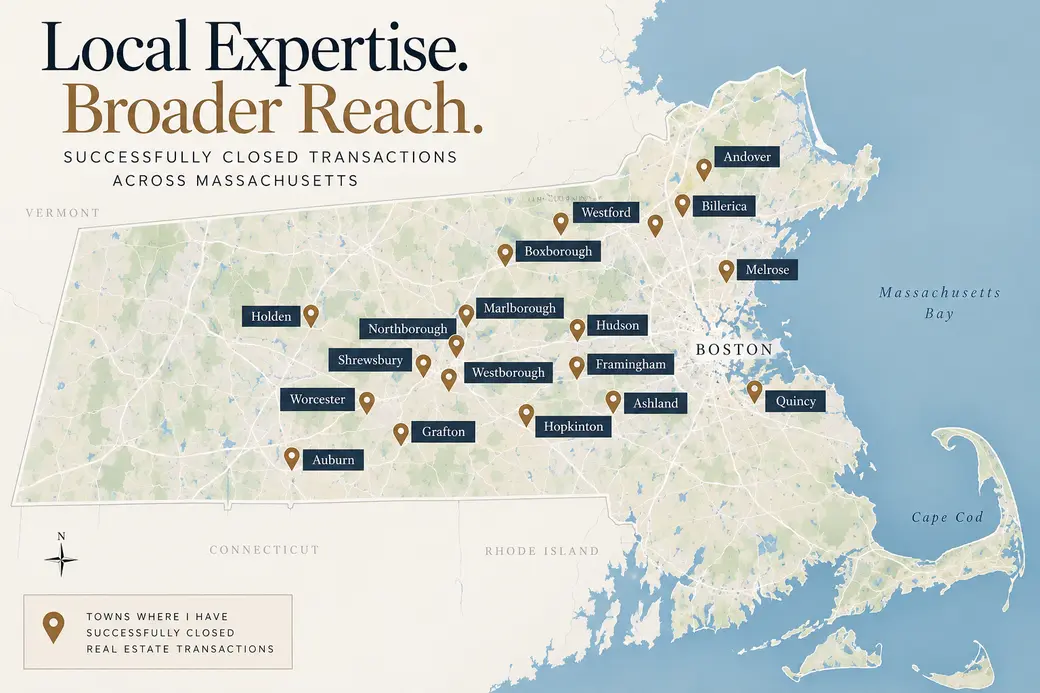
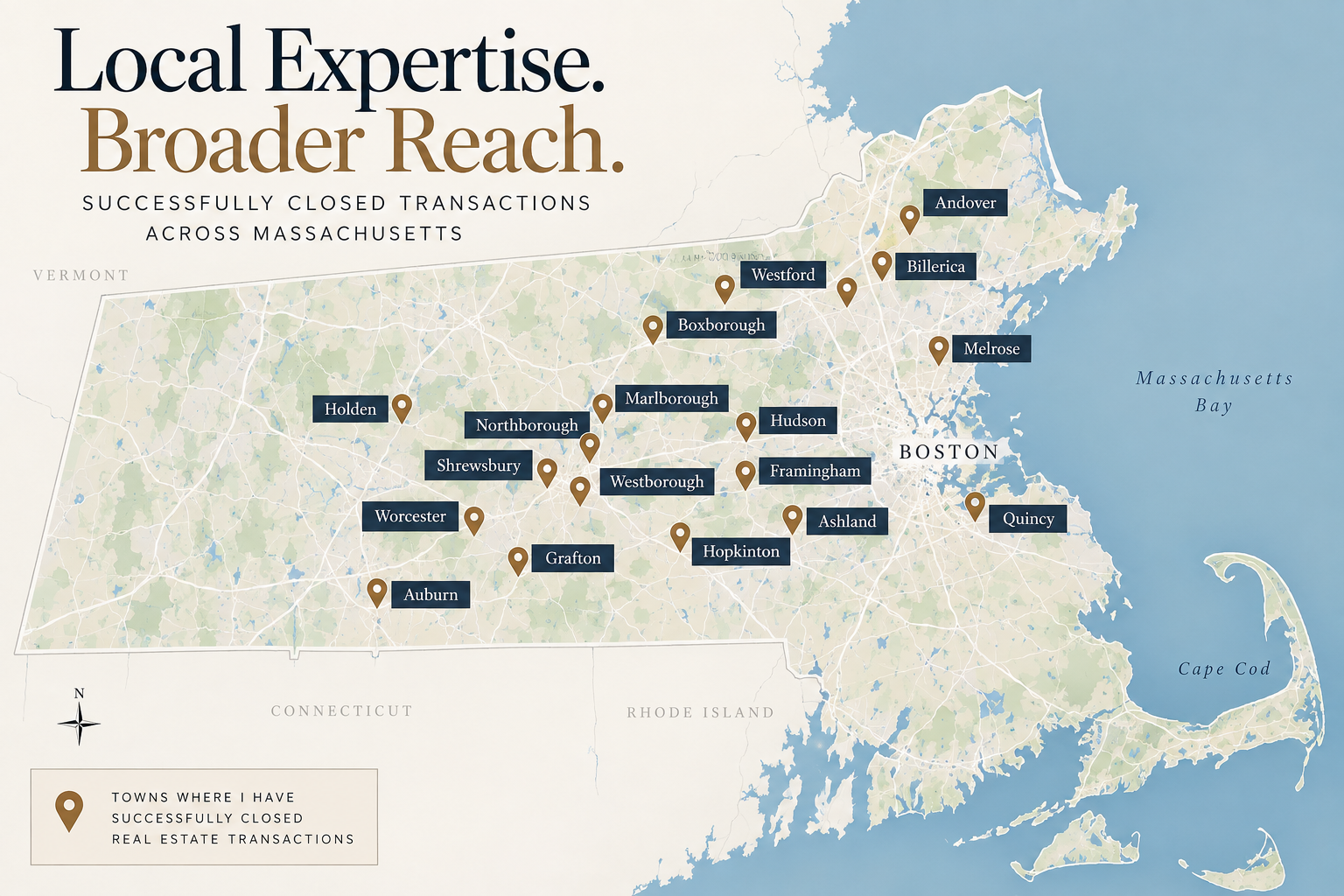
My own real estate experience has taken me across Massachusetts, with successfully closed transactions in Shrewsbury, Hopkinton, Andover, Quincy, Westborough, Hudson, Framingham, Marlborough, Melrose, Grafton, Boxborough, Westford, Ashland, Worcester, Auburn, Billerica, Holden, and Northborough.
Working across different communities has reinforced something I believe strongly: effective real estate representation is about more than familiarity with a ZIP code.
Marketing ability, responsiveness, negotiation skills, professional networks, understanding current market data, and whether an agent is actively working in real estate full time can all have a meaningful impact on the experience a client receives.
The right real estate agent for your home may not be the agent with the most signs in your neighborhood. It may be the agent who brings the right strategy, attention, resources, and expertise to your specific transaction.
Local Knowledge Matters—But It Is Only One Part of the Job
There is genuine value in understanding a local real estate market. An experienced agent should be able to research recent comparable sales, current competition, pricing trends, buyer demand, property characteristics, and other factors that can affect a transaction.
But today, much of that information is not confined to someone who happens to live or work within a particular town.
Professional real estate agents have access to MLS data, public property records, historical sales information, market statistics, and professional networks that allow them to thoroughly research a market before advising a client.
A strong agent should never pretend to know a market they haven't researched. Instead, they should be able to show you the data behind their recommendations.
When interviewing an agent, consider asking:
-
How did you arrive at your recommended price?
-
Which comparable properties are most relevant to my home?
-
Who do you believe the likely buyer for this property will be?
-
How will you market my home beyond simply entering it into MLS?
-
What challenges do you anticipate with this property or transaction?
-
How available will you be once we are under contract?
The answers may tell you considerably more than the number of homes an agent has sold on your street.
A Broader Buyer Network Can Be an Advantage
Your eventual buyer may not currently live in your town.
Massachusetts buyers frequently search across several communities based on factors such as commute, housing inventory, price range, property style, taxes, schools, lot size, and lifestyle.
An agent who regularly works across multiple markets may have relationships with buyers, agents, lenders, attorneys, inspectors, and other real estate professionals throughout a wider geographic area.
For sellers, that broader perspective can be valuable.
Rather than marketing a property exclusively to people already focused on one community, the agent can consider how the home competes with properties in surrounding markets and how to position it for buyers who may not initially have considered the town.
Fresh Eyes Can Change How a Home Is Positioned
Familiarity can be useful, but a fresh perspective has value too.
An agent who does not approach your property with years of assumptions about the neighborhood may notice selling points that deserve greater emphasis or identify a different target buyer.
Perhaps your home offers substantially more land than buyers can obtain at the same price in a neighboring town. Maybe its location creates a practical commuting option for buyers searching elsewhere. Perhaps its layout, renovation potential, outdoor space, or price point makes it competitive with homes in several nearby communities.
Effective real estate marketing isn't simply about describing a house.
It is about understanding who is most likely to buy it, what matters to that buyer, and how to position the property accordingly.

Your Listing Should Be Marketed—Not Simply Listed
Nearly every residential listing ultimately appears on major consumer real estate websites through MLS syndication. That means putting a property online is only the beginning of a marketing strategy.
A thoughtful listing strategy may include professional photography, compelling listing copy, digital marketing, social media exposure, direct outreach, agent-to-agent networking, database marketing, open houses when appropriate, and continued evaluation of buyer response after the property reaches the market.
An agent who works across several communities may also bring marketing channels and professional relationships that extend beyond your immediate area.
When interviewing agents, ask them to explain exactly what they plan to do after your home goes live.
“Put it in MLS and wait” is very different from actively marketing a property.
An Objective Pricing Strategy Can Be Valuable
Pricing a home is one of the most important conversations between a seller and a real estate agent.
A good pricing recommendation should be supported by relevant market evidence rather than reputation, neighborhood familiarity alone, or the price a seller hopes to achieve.
An agent approaching the property with fresh eyes may evaluate it primarily against the current competitive landscape:
What has recently sold?
What failed to sell?
What is currently competing for the same buyer?
How long are comparable homes taking to sell?
How does your home's condition, location, size, layout, and price point compare?
The objective isn't to tell a seller the highest number. It is to develop a pricing strategy that makes sense in the current market and supports the seller's larger goals.
Full-Time vs. Part-Time Real Estate Agent: Why Availability Matters

Another factor consumers should consider is whether their real estate agent works in the business full time.
Being a part-time agent does not automatically make someone a poor agent, just as working full time does not automatically make someone excellent. However, real estate transactions move quickly, and an agent's availability and day-to-day involvement can make a meaningful difference.
A full-time real estate agent is immersed in the market every day. They are communicating with other agents, reviewing new inventory, monitoring price changes, negotiating transactions, coordinating inspections and appraisals, communicating with attorneys and lenders, and navigating issues as they arise.
That constant exposure can provide valuable context that is difficult to obtain from market statistics alone.
Real Estate Does Not Operate on a 9-to-5 Schedule
Offers may arrive in the evening. Inspection issues can require immediate attention. A lender may need documentation. An attorney may raise a contract concern. A buyer may want to see a newly listed property before the weekend.
In competitive markets, waiting until someone finishes another job before responding may not always be practical.
For buyers, a full-time agent may have greater flexibility to schedule showings quickly and monitor new inventory.
For sellers, it can mean having someone available to respond to showing feedback, communicate with buyer agents, evaluate offers, manage deadlines, and address problems throughout the transaction.
Experience Is Built Through Repetition
There is another important distinction between simply holding a real estate license and actively practicing real estate.
Agents who are consistently involved in transactions encounter inspections, appraisal issues, financing challenges, negotiations, title questions, contractual deadlines, and unexpected complications on a regular basis.
That repetition builds practical experience.
Consumers should therefore ask more than, “How many years have you been licensed?”
Ask how actively the agent is currently working in the business and what their role will be throughout your transaction.
The Most Important Question: Who Will Actually Represent You?
Whether an agent is highly local or works throughout a broader region, the relationship ultimately comes down to representation.
Who answers when you have a question?
Who analyzes the offers?
Who negotiates on your behalf?
Who follows up when something is delayed?
Who notices when a deadline or contractual detail requires attention?
And who will tell you something you may not necessarily want to hear when the market data points in a different direction?
A recognizable name or large local presence can be reassuring, but consumers should understand exactly who will be handling their transaction and how accessible that person will be.
How to Choose the Right Real Estate Agent
Instead of choosing an agent based solely on geography, interview potential agents about the complete service they provide.
Look at their knowledge of the market, ability to interpret data, marketing strategy, communication style, responsiveness, negotiation experience, professional network, availability, and understanding of your goals.
Ask them to explain their recommendations rather than simply giving you conclusions.
A great agent should be comfortable saying:
“Here is what the data shows, here is what I recommend, and here is why.”
That approach allows you to make an informed decision while knowing you have an experienced professional advocating for your interests.
Do I Need a Real Estate Agent Who Lives in My Town?
No. A real estate agent does not necessarily need to live in your town to effectively represent you.
What matters is whether the agent understands—or can thoroughly research—the relevant market, has access to appropriate market data and professional resources, and can provide the level of service your transaction requires.
For sellers, the right agent should be able to analyze comparable properties, understand current competition, develop an appropriate pricing and marketing strategy, and communicate effectively with buyers and their agents.
For buyers, the agent should be able to research communities and properties, identify relevant market information, coordinate showings, analyze comparable sales, prepare offers, and guide the transaction from offer through closing.
Is a Local Real Estate Agent Always Better?
Not necessarily.
A highly experienced local agent may be an excellent choice. But geography alone does not determine an agent's marketing ability, responsiveness, negotiation skills, attention to detail, or commitment to a client.
The better question is not simply:
“Who sells the most homes in my town?”
It is:
“Who is best prepared to represent me, my property, and my goals?”
Full-Time or Part-Time Realtor: Which Should I Hire?
Both full-time and part-time real estate agents can be licensed professionals, and individual experience varies considerably.
However, consumers should consider how available an agent will be during the transaction, how frequently they are actively working with buyers and sellers, how many transactions they handle, and how quickly they can respond when an issue requires attention.
Real estate transactions involve multiple parties and strict deadlines. Availability, communication, and current transaction experience should therefore be part of your decision when interviewing an agent.
The Right Agent Brings More Than a ZIP Code
The right real estate agent is not necessarily the person whose office is closest to your house.
It is the professional who understands your goals, does the research, communicates clearly, markets strategically, negotiates thoughtfully, and remains engaged from the beginning of the transaction through closing.
Sometimes deep neighborhood experience is exactly what a client needs.
Other times, a broader market perspective, expanded professional network, fresh marketing strategy, and dedicated full-time representation may bring something equally valuable to the table.
Choose the agent—not simply the ZIP code.
Looking for a Massachusetts Real Estate Agent?

I'm Wajeeha Nasir, Realtor® with Northbound Realty Co. I work with buyers and sellers across Massachusetts, combining market data, thoughtful strategy, personalized representation, and a broader perspective on how homes compete across communities.
Whether you're preparing to sell your home or trying to determine where to buy next, my approach starts with understanding your goals and building a strategy around them.
Curious about where your home stands in today's market?
Visit dwellingsbyw.com to connect with me and start the conversation.
Rooted in integrity, focused on you.
Categories
Recent Posts







"My job is to find and attract mastery-based agents to the office, protect the culture, and make sure everyone is happy! "